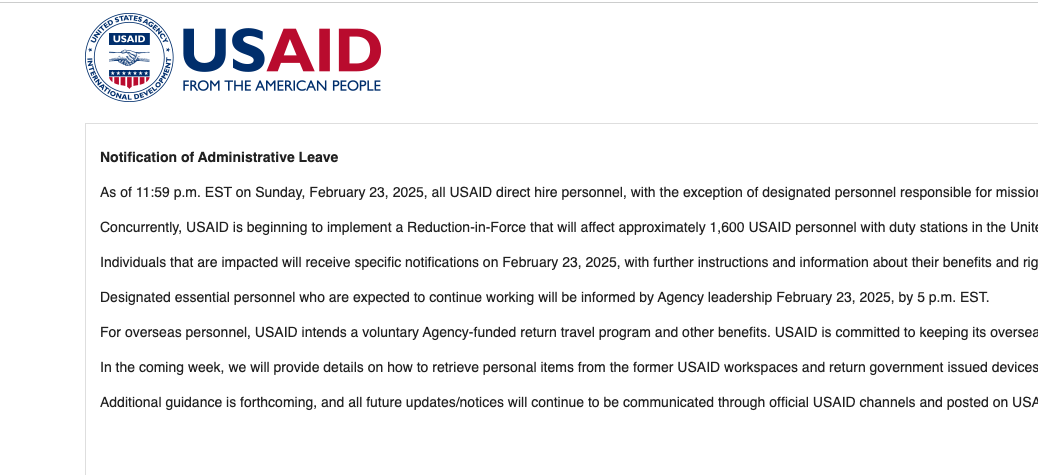
The shuttering of USAID by the Donald Trump administration will have “a dramatic impact on humanitarian aid projects around the world”, EU crisis management commissioner, Hadja Lahbib, told MEPs last month.
That is putting it mildly.
Hours after the Trump administration announced a series of limited waivers to allow emergency food aid and some HIV/AIDS programmes to continue on 1 February, the website of USAID, which manages most of the roughly $60bn [€55.3bn] US aid budget, was offline.
Though the executive orders on 20 January and 1 February imposed a 90-day freeze on aid programmes that is due to expire in April, USAID officials in Kenya and elsewhere say privately that most cuts will be made permanent.
Some African leaders, like former Kenyan president Uhuru Kenyatta, have said that the end of USAID and thousands of expatriate jobs in the aid industry offers an opportunity for governments to end their aid dependency.
That is true in theory. The reality, at least in the short and medium-term, is of deep cuts to social spending across swathes of the developing world, particularly to health and education, and hundreds of thousands of people being unable to get the HIV/AIDS, TB and malaria medication they need.
Hundreds of thousands of lives
In South Africa and Kenya, health ministry officials have warned that hundreds of thousands of lives could be lost by 2030 if patients are unable to pay for antiretroviral medicine.
It could offer an opportunity for rival powers to increase their aid and reap the diplomatic benefits and influence that such soft power brings. But nobody appears ready to take it.
Though EU Commission officials in Brussels have said that they will, where possible, bring forward payments to partners facing cash flow crises, the EU and its member states have been cutting aid for several years.
“Before we get on our high horse, let us not forget that the EU’s development policy is heading in the same direction albeit without the scorched earth approach,” says MEP Barry Andrews, the liberal chair of the European Parliament’s development committee.
The EU Commission will update the provision of foreign aid and make it more “targeted for partners,” the EU executive said in February as part of plans to restructure its foreign aid to meet its strategic interests, including strengthening alliances with like-minded countries, securing access to raw materials, and curb the influx of migrants.
The Organisation for Economic Co-operation and Development estimates that net official development assistance to sub-Saharan African countries has shrunk by 7.8 percent compared to 2021, largely as a result of the billions of euros provided for Ukraine since Russia’s full-scale invasion in February 2022.
European cuts — in detail
Further, deeper cuts are on the way. France plans to reduce public development aid by up to 40 percent as part of €32bn of cuts in 2025, cutting aid by more than €2bn, while Germany, the EU’s biggest donor, will cut its humanitarian aid from €2.23bn to €1.04bn this year.
Others such as Sweden, one of the few EU states to currently meet the UN target of spending 0.7 percent of gross national income on aid, are also cutting their budgets.
The Netherlands, for example, in February set out plans to cut its annual development budget by €2.4bn from 2027, reducing the total budget from €6.1bn to €3.8bn. This will cut Dutch aid spending as a percentage of GNI from 0.62 percent in 2024 to 0.44 percent by 2029. The conservative government in the Hague will make the deepest cuts to climate and gender equality programmes.
The Dutch plan to increase aid spending on migration control, including potential agreements with individual countries on repatriation and returns.
Less than two weeks ago, the UK’s prime minister Keir Starmer announced that the UK would cut its aid budget from roughly 0.5 percent of gross national income to 0.3 percent as part of a plan to increase defence spending to 2.5 percent of GDP. His development minister, Anneliese Dodds, resigned in protest.
With the exception of countries facing internal conflict, famine or natural disasters, healthcare is the largest budget heading for aid spending and is almost certain to be the main victim of cuts. In the case of the US, spending on HIV/AIDS programmes accounted for over $1.5bn last year in sub-Saharan Africa.
Though the Trump administration issued a limited waiver for some programmes under the President’s Emergency Plan for AIDS Relief (PEPFAR), most of that $1.5bn will be lost.
Half a million HIV deaths over next decade?
The results are already starting to emerge.
Harry Kimtai, a junior health minister in Kenya, told the national parliament in Nairobi at a hearing on 19 February that the loss of US aid will leave a $220m hole in this year’s healthcare budget. His government has already reclassified HIV/AIDS and TB drugs as “pandemic” rather than “chronic” conditions, meaning that patients will no longer be able to receive them for free.
Linda-Gail Bekke, the head of the Desmond Tutu HIV Foundation in South Africa, has warned that the USAID cuts will result in more than 500,000 deaths from HIV/AIDS over the next decade.
Alongside healthcare, climate finance is likely to see major cuts.
Last week, the Trump administration announced the end of its support, estimated at around $1.5bn, for South Africa’s Just Energy Transition Programme, an $8bn programme designed to end South Africa’s reliance on coal and move towards renewable energy. Providing more than $3bn, the EU is the main donor to the JETP. The US has also ended its involvement in JETPs with Indonesia and Vietnam.
The EU has not said whether it will increase its funding to help plug the gap left by the US, though the programme will be on the agenda at the EU-South Africa summit in Johannesburg starting on 13 March.