Newsletter
87 days to election: Hungary sees widening gap in favour of Tisza over Orbán's Fidesz
In this new weekly series, award-winning journalist Veronika Munk summarises and explains the most important public affairs developments from Hungary.
We accompany readers along the historic road to the April 2026 election — a contest without precedent in the region over the past decade and a half. This week, we cover:
1. According to the latest opinion polls, the Tisza Party’s lead over Fidesz has continued to grow, particularly among committed voters.
2. Fidesz has presented its 106 candidates, deliberately renewing its slate in constituencies where polling suggests individual seats may be at risk.
3. The governing party’s campaign was overshadowed by a communications blunder after Tisza secured the domain linked to Fidesz’s new campaign slogan.
4. It has become official that Hungary’s parliamentary elections will be held on 12 April 2026.
5. A sharp dispute has erupted between Péter Magyar and Slovakia’s state leadership over the Beneš Decrees and the use of the term “Felvidék”.
6. Tensions were further fuelled by Hungary granting political asylum to former Polish government officials.
Follow Hungary’s road to the 2026 election — subscribe to Days Until the Hungarian Elections on Substack and get every edition straight to your inbox.
This week's polls: the scissors open between Tisza and Fidesz
According to the latest survey by the polling institute Medián, the opposition Tisza Party has further extended its lead over the governing parties. Led by Péter Magyar — a new opposition figure who previously moved within the orbit of the governing elite — Tisza has become Viktor Orbán's Fidesz party's most serious challenger.
In November, Tisza held a 10-percentage-point advantage over Fidesz; by January, this gap had widened to 12 points among voters certain to choose a party. The data suggest that Tisza has not primarily drawn support away from Fidesz, but rather from smaller opposition parties, whose backing has visibly shrunk.
Some have all but vanished from the political map — the once significant Democratic Coalition, for instance, has fallen to around one percent support.
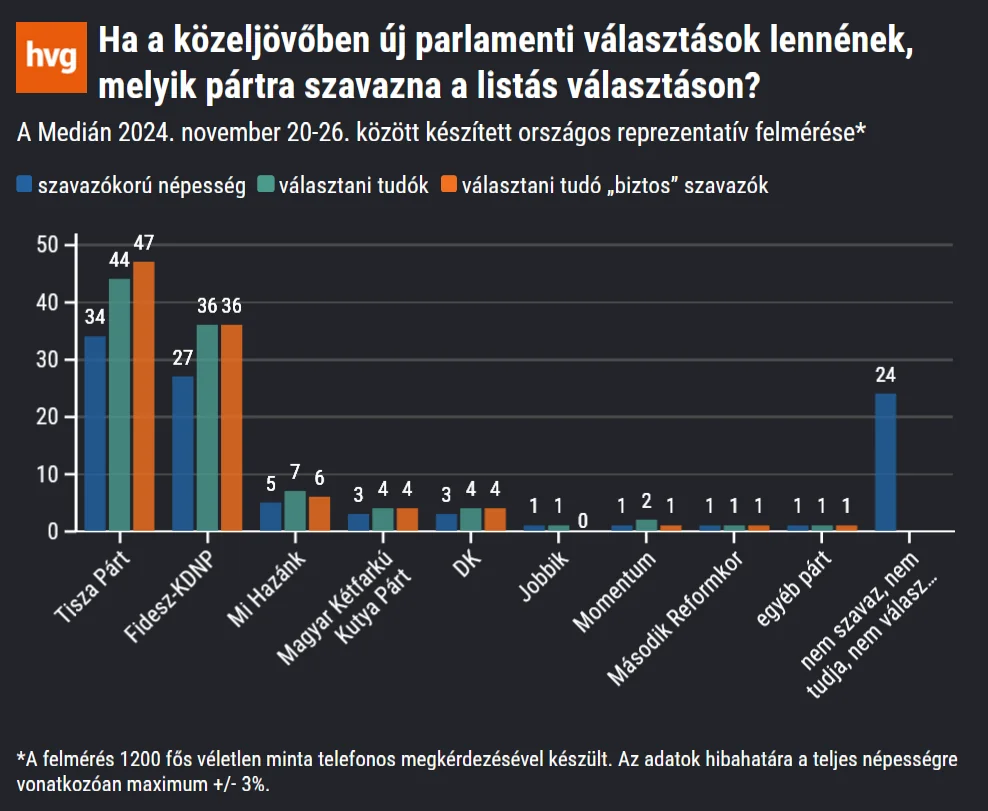
Tisza is attracting an ever larger share of former opposition voters. Alongside growth among the adult population as a whole, it has also built a stable lead among committed voters, while Fidesz's support has at best stagnated and in some groups has slightly declined.
Measurements published this week by another research institute, Idea, point in the same direction: Tisza leads the governing alliance by a substantial margin of around 10 percentage points among both the full population and active party voters.
At this point four years ago, Fidesz was already leading the then-united opposition bloc. In the past 16 years — throughout Fidesz's uninterrupted rule since 2010 — Hungary has not seen such a deficit for the governing party, especially not this close to an election.
Fidesz unveils its 106 candidates
By way of reminder: in Hungary's 199-seat parliament, 106 MPs are elected in single-member constituencies on a first-past-the-post basis, while the remaining 93 mandates are allocated proportionally from national party lists.
This system favours larger parties, as constituency victories and list votes are aggregated.
The opposition Tisza Party already presented its candidates in November, fielding exclusively newcomers with no prior political careers. Fidesz has also refreshed its line-up, replacing its 2022 candidates in 42 constituencies.
The new nominees, however, are far from political outsiders: many come from within the political class and state administration, including county government commissioners, mayors, deputy mayors, and district office heads. The selection reflects a clear strategic calculation: Fidesz has primarily renewed candidates in constituencies where polling indicates that the party's hold is weakening and Tisza appears more competitive.
Another notable change is the number of women candidates. Fidesz is fielding twice as many women as in 2022 — yet the figure remains strikingly low: just 14 out of 106 candidates, or 13.2 percent.
By comparison, women make up around one third of Tisza's slate. Fidesz's poor gender balance comes as little surprise, given that the current government includes no female ministers at all.
Magyar trolls Fidesz’s candidate congress
Fidesz held its party congress over the weekend, where it presented both its 106 candidates and its campaign slogan for 2026: “A safe choice”.
Orbán explained the slogan in a Facebook post: "In an uncertain world, the greatest value is security. People have always been able to rely on us," he wrote.
However, a major oversight quickly became apparent: the party had failed to secure the internet domains associated with the slogan. Tisza's team spotted the omission immediately and registered biztosvalasztas.hu on the spot.
Visitors to the site are now greeted with a message urging those who do not want oligarchs to vote for Tisza. The party has even applied for trademark protection for the domain. Shortly afterwards, Magyar announced that he would be willing to sell the domain to Fidesz for five billion forints (around €13m), using the proceeds to buy firewood for families unable to afford heating.
Election date officially set for 12 April 2026
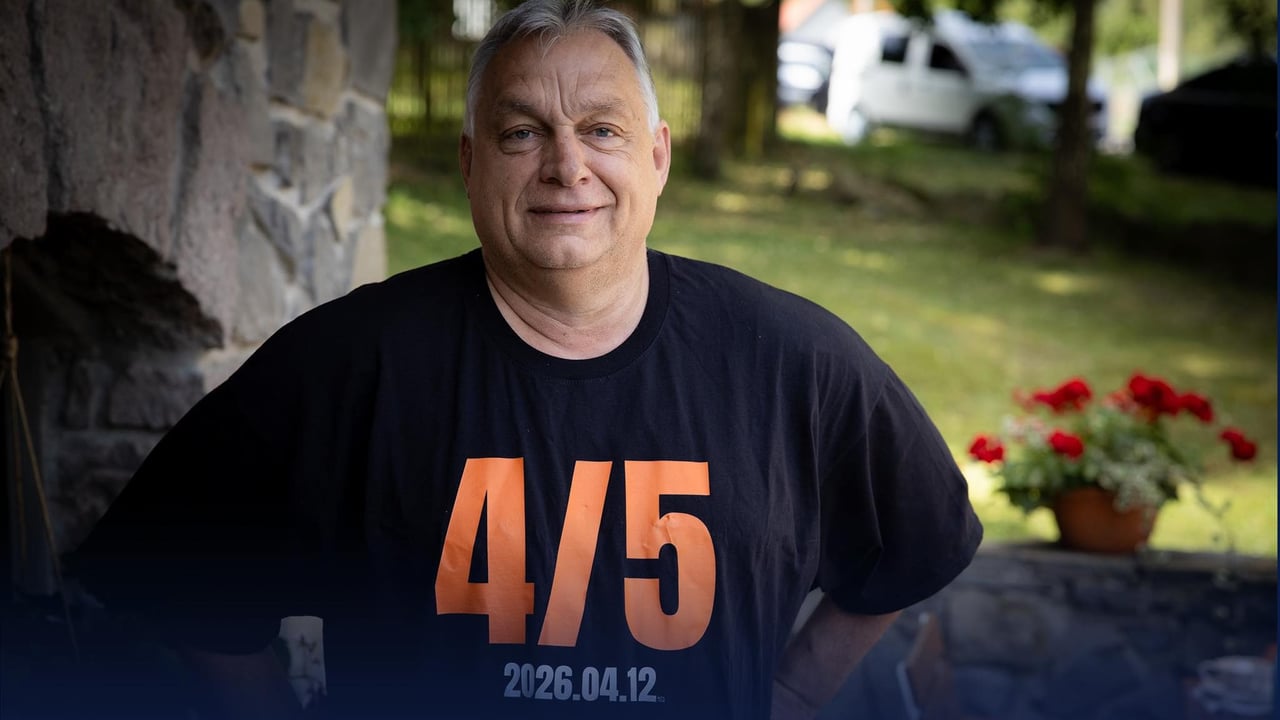
Hungary's president formally called the parliamentary election this week for 12 April 2026. The announcement came as no surprise: senior Fidesz figures, including the prime minister himself, had repeatedly hinted at the date. Last summer, Orbán even posed in a photo wearing a T-shirt emblazoned with "12 April 2026".
Public dispute escalates between Magyar and Slovakia's leaders
A public row has broken out between Péter Magyar, leader of the opposition Tisza Party, and Slovakia's state leadership.
The dispute followed an open letter in which Magyar urged Slovak PM Robert Fico to repeal a Slovak law criminalising criticism of the Beneš Decrees, and called on Viktor Orbán to support a related petition.
As reported in detail last week, the new legislation threatens up to six months in prison for those who question the decrees, even though they continue to serve as a legal basis for land confiscations affecting ethnic Hungarians in Slovakia.
The Beneš Decrees are post-Second World War measures — still legally effective — that imposed collective guilt and confiscation of rights and property on Hungarian and German minorities.
Orbán has so far refrained from substantive comment, largely because he pursues a pragmatic, conflict-avoiding policy towards Fico's government for EU-alliance reasons.
Slovakia's president, Peter Pellegrini, has spoken out, accusing the Slovak opposition of raising the issue to serve Hungary's domestic campaign and specifically objecting to Magyar's use of the term Felvidék ( which means Upper Hungary) to describe Hungarian-inhabited areas of Slovakia.
In this context, Felvidék is a historical geographical term referring to the northern territories of the former Kingdom of Hungary, most of which now lie within Slovakia and are home to a significant Hungarian minority.
For many Hungarians, the term is tied to identity and historical memory, while in Slovak political discourse, it is sensitive and associated with questions of sovereignty. The dispute does not concern territorial claims, but rather memory politics and identity.
Magyar responded by saying that he uses geographical names according to his family and historical tradition, and will therefore continue to refer to the region as Felvidék/Upper Hungary and to Bratislava as Pozsony.
He also broadened the debate beyond language, raising cultural demands such as ending the Slovakisation of historic Hungarian aristocratic names and providing Hungarian-language information at historical sites.
Hungary grants asylum to former Polish politicians
Former Polish deputy justice minister Marcin Romanowski received asylum in Hungary at the end of 2024, while his former superior, ex-justice minister Zbigniew Ziobro, was granted refugee status in late 2025 or early 2026.
Polish authorities have charged Ziobro with 26 counts of corruption. The Hungarian government justified its decision by claiming that the proceedings amounted to a "political vendetta" and that the individuals concerned would not receive a fair trial in their home country.
The European Commission responded swiftly. EU commission spokesperson Markus Lammert stressed that within the EU, the general principle is that all member states are considered safe countries, meaning there is, in principle, no general justification for an EU citizen to obtain refugee status in another member state.
In an interview with Hungarian outlet 444, Polish foreign minister Radosław Sikorski strongly condemned Hungary's actions, accusing the government of sheltering — in his view — criminals. "Corrupt nationalism is not patriotic. Under the rule of corrupt nationalists, Hungary has become the poorest country in the European Union," he said.
In response, Hungarian foreign minister Péter Szijjártó dismissed Sikorski as a "fanatical, pro-war Soros agent".
The dispute further complicates Polish–Hungarian relations and EU solidarity ahead of the new EU asylum framework due to enter into force in 2026.
Under the agreement, Poland may seek partial or full exemptions from relocating asylum seekers or making financial contributions, while Hungary has not been granted such opt-outs.
As a result, while Budapest offers asylum to Polish politicians, it would still be obliged under EU solidarity mechanisms either to take in asylum seekers or to pay substantial sums — €20,000 per person — into the common fund.
This week's heart-warming story: Hungarian authorities join forces to rescue a duck frozen in the Danube
Hungarian police, firefighters, disaster management services and a rescue diving unit worked together to save a wild duck frozen into the ice on the Danube.
The rescue was reported by 444: one of its readers alerted the police, who mobilised several agencies. Around 30 minutes after the frozen duck was spotted, specialists succeeded in freeing the bird. If only everything in Hungary worked this smoothly.
Author Bio
Veronika Munk is an award-winning Hungarian journalist with more than 20 years of experience. She works as director of innovations and new markets at Denník N, the leading independent Slovak news outlet, which also has Czech and Hungarian language versions.
Prior to her current role, Veronika held various senior positions at several other leading Hungarian independent news outlets. She was the founding editor-in-chief of the Hungarian independent online daily news outlet Telex, and before that, she was deputy editor-in-chief at Index, Hungary’s largest online daily news outlet. Veronika has a PhD in media studies and teaches journalism courses at ELTE University, the largest Hungarian university.
Related articles
Tags
Author Bio
Veronika Munk is an award-winning Hungarian journalist with more than 20 years of experience. She works as director of innovations and new markets at Denník N, the leading independent Slovak news outlet, which also has Czech and Hungarian language versions.
Prior to her current role, Veronika held various senior positions at several other leading Hungarian independent news outlets. She was the founding editor-in-chief of the Hungarian independent online daily news outlet Telex, and before that, she was deputy editor-in-chief at Index, Hungary’s largest online daily news outlet. Veronika has a PhD in media studies and teaches journalism courses at ELTE University, the largest Hungarian university.