Feature
Mediterranean’s hidden forests under siege by tourism
On a quiet June afternoon in Sardinia’s Arcipelago della Maddalena National Park, two local women watch in frustration as a boat approaches too close to Cala Andreani, in Caprera island. Anchoring is prohibited there to protect the seagrass meadows beneath the surface — yet, as they lament, “tourists constantly ignore the rules.”
Their concern reflects a growing Mediterranean-wide problem: the degradation of posidonia oceanica, one of the planet’s most effective long-term carbon sinks and a foundation of coastal ecosystems.
Few holidaymakers are aware that the underwater meadows they swim above are formed not by algae, but by this endemic plant unique to the Mediterranean and essential to the survival of many of its species.
Covering nearly two million hectares across the sea, these green valleys host 20 percent of the Mediterranean’s biodiversity. But the tourism industry that sustains the economies of Mediterranean islands poses a grave threat to posidonia’s survival.
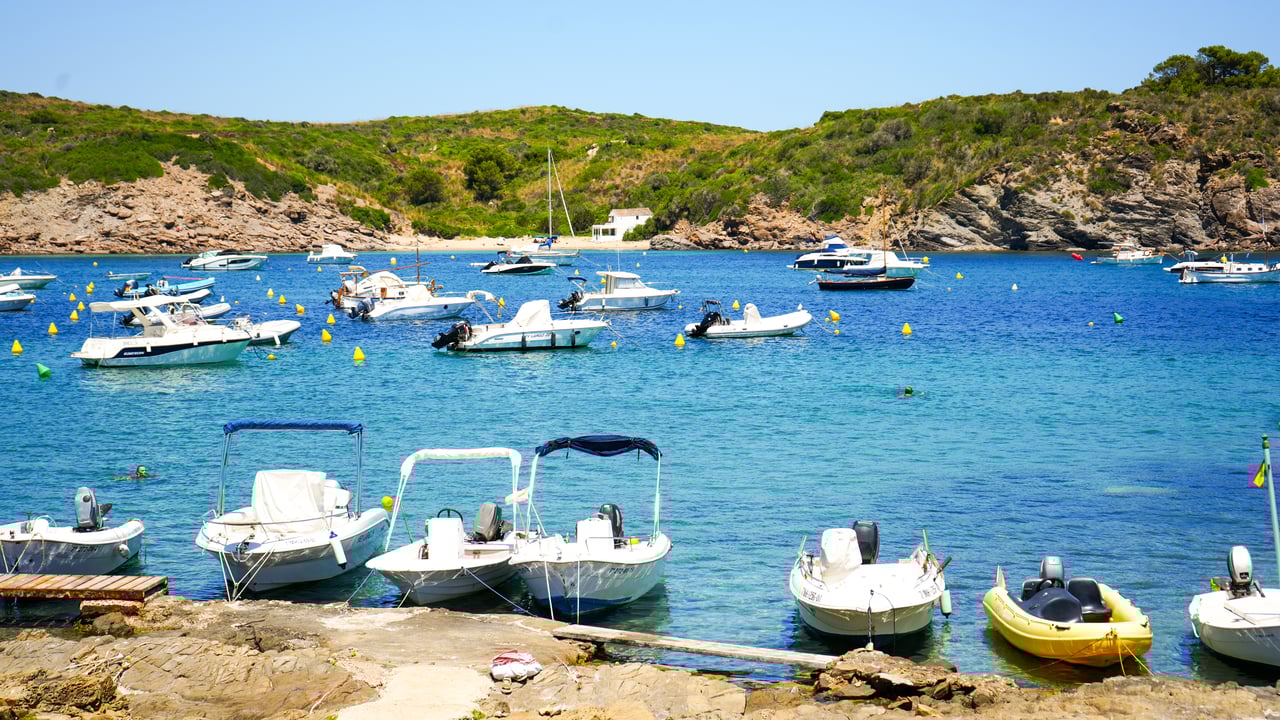
The visitor record numbers speak for themselves: in 2024 there were 18.7 million in the Balearics, 4.5 million in Sardinia, 3.1 million in Corsica. With airports overflowing, cruise ships docking daily and marinas filled to capacity, the tourist boom is exacerbating ecological fragility.
Scientists agree on the plant’s exceptional role. An international study from 2012 claimed that posidonia potentially stores “11 to 89 percent of CO2 emissions produced by Mediterranean countries since the Industrial Revolution.”
A 2025 global study stated that all seagrasses, which cover only 0.2 percent of the ocean floor, absorb 10 percent of the carbon the oceans take up annually, with posidonia having the highest long-term storage capacity among seagrasses.
However, this plant grows just one square centimetre a year, taking up to six centuries to form a single hectare. Anchors that rip up the seabed can undo millennia of carbon storage in minutes.
Protecting habitats but not quite
Under EU law, posidonia has been a protected habitat since 1992. A 2006 EU regulation banned trawling in marine protected areas containing the plant.
These laws helped curb some damage although several studies show that trawling continues.
Over the past decade, tourism has expanded to unprecedented levels, exerting significant pressure on posidonia meadows, which have never received the endorsement of a national law properly banning anchoring on the plant and only local regulations apply across the region.
Across Spain’s Balearic Islands, legislation is clear, but the reality is murky. Spanish law made the Balearics the first Mediterranean region to ban anchoring on seagrass outright. It also prohibited trawling, dumping, the construction of submarine cable projects and port expansions in areas where seagrass is present. Offenders face fines of up to €450,000.
However, laws don’t necessarily translate into enforcement.
In the Balearic islands, the Posidonia Surveillance Service operates seasonally but most of its staff cannot issue fines.
Boat drivers travel with environmental agents (who can issue fines) only occasionally. In 2024, authorities asked 6,764 vessels across the islands’ waters to relocate; just 43 were fined.
Apps such as Donia help boaters find safe anchoring spots, but they remain little known among tourists. The apps are popular in Spain and France but not in Italy, where official mapping of the plant meadow - the most ambitious attempt worldwide to map posidonia ever - is still underway.
However, the toughest challenge is controlling small rental boats.
“There are 3,600 registered recreational boats, but more than twice as many illegal ones,” says Pedro Francisco Gil, president of the Balearic Charter Companies Association.
Despite increased monitoring with drones and other tools, enforcement is still lacking. “There are inspections, but there is a lack of police presence,” he points out.
Corsica: Chasing the Mega-Yacht
Corsica introduced strict rules in 2020: yachts over 24 meters must anchor at least 300 meters offshore, with possible fines of €100,000 and the threat of banishment from French waters. Wealthy owners now attempt to avoid restrictions by building vessels just under 24 meters.
Enforcement is difficult: “To impose a fine, you need a photo of the anchor being lifted with uprooted plants,” explains Michel Mallaroni, director of the Port of Bonifacio.
"We can’t do anything,” admits Julien Courtel, a police officer with the French Ministry of Ecological Transition, as he inspected a yacht in Corsica.
After verifying the registration papers, the vessel, compliant because it is shorter than 24 meters by just a few centimeters, didn’t have to move.
Between 2010 and 2018, the number of anchorings by yachts between 24 and 60 meters in French Mediterranean waters increased by 449 percent.
However, according to a study published this year, since the French law was approved, large-yacht illegal anchorings on posidonia in Corsica have dropped dramatically — from 13,630 before 2020 to 1,955 in the past year. According to research by Quentin Fontaine, an oceanographer at the Calvi Marine Research Station, “Since the yacht-anchoring ban, posidonia is no longer declining”.
Interestingly, there are only ten patrol boats to monitor the 1,000 kilometers of Corsican coastline.
Only two yachts were fined in 2024, and just a handful of shipowners and captains have had to pay up to €100,000 since the law was passed. When boats break the rules, in most cases they are merely asked to move elsewhere. Still, the law appears to serve as a deterrent.
Mooring, regenerating, protecting
Unlike France, Italy has no specific law banning anchoring on posidonia. Regulations vary by region. In Sardinia’s Maddalena Archipelago National Park, which is home to some of the most pristine seagrass beds in Italy, only 8 percent of its waters are protected.
“Without a national law, our hands are tied,” says park director Giulio Plastina, who lacks the staff or authority to enforce even local rules. In 2024, the Coast Guard of the island of La Maddalena fined 29 vessels €50 for crossing into protected areas, a very small number considered that in 2024 alone the park issued 13500 permits to sail in its waters.
One solution is the installation of mooring buoys, which boats can tie up to and which prevent damage to marine ecosystems. Plastina’s plan is to make them mandatory to anchoring within the park.
“You will have to register, and once all the buoys are occupied, that’s it. Right now, boats are all over. We need to control the number of boats, otherwise it is very difficult to protect an ecosystem as fragile as this,” he explains.
In fact, a WWF report released in June estimated that 50,000 hectares of posidonia were destroyed by anchoring across the Mediterranean in 2024, with Italy the hardest hit, followed by Spain.
Faced with the accelerating loss of seagrass throughout the Mediterranean, researchers have been experimenting with restoration for years, but it is a small scale solution.
For scientist Jorge Terrados, an expert on posidonia restoration, we shouldn’t forget the main goal: “The strategy must be to protect the meadows we still have,” he says. “Not a single square meter should be lost. And if we do lose ground, then we can use replanting to speed up the recovery.”
Marine biologist Roberto Barbieri is even more blunt: “Action is needed at multiple levels, and above all, anchoring on posidonia must be banned across the Mediterranean.”
This investigative report was made with the support of the JournalismFund Europe
Author Bio
Alban Leduc is a freelance journalist specialising in environmental issues, based in northern France.
Barbara Celis is a Spanish freelance reporter currently based in Rome. Previously, she worked as a correspondent in New York for El País, and as a journalist for several media in London and Taipei. She focuses on culture and climate change.
Ana López García is a freelance journalist and photographer based in Paris. She specialises in environmental and social issues and has reporting experience across Europe, Africa, and the Middle East.