Investigation
Bolshoi-loving banker threatened Euroclear CEO, amid EU talks on Russian assets
A French banker with close ties to Russia who works inside Euroclear has allegedly threatened its CEO, amid knife-edge EU talks on the Belgian firm's handling of frozen Kremlin assets.
The banker, Olivier Huby, is a board member of Mfex, a subsidiary of Belgian financial-services giant Euroclear, which holds €193bn of Russian Central Bank assets, immobilised due to EU sanctions over Russian president Vladimir Putin's full invasion of Ukraine in 2022.
Huby has no formal managerial or advisory role in the group, but his position has given him privileged access to Euroclear's top executives, in the run-up to EU negotiations with Belgium on using the Russian money to buy arms for Kyiv and cover basic needs.
Yet at the same time, Huby has such strong ties to Russia that he has flown there 155 times in the past 10 years, according to a joint investigation by EUobserver, Belgian magazine Humo, Belgian newspaper De Morgen, and the UK-based NGO Dossier Center.
And Huby has abused his Euroclear privileges by trying to organise meetings between its CEO, Valérie Urbain, and his Russian intelligence contacts, according to our sources.
Huby also threatened her and a second Euroclear executive when they refused, our sources said.
But Urbain was declined Belgian police protection.
Belgian intelligence was unable to investigate Huby, as he lived in France and Sweden.
And Euroclear's French security firm had never heard of him — despite the red flags around his behaviour.
That posed serious questions about whether Euroclear, an EU prize jewel, which held €41 trillion of foreign assets under management, was adequately defended.
And it raised questions if its executives were briefing Belgian authorities, EU officials, or media while under private duress.
Urbain, for one, told French newspaper Le Monde on 15 November - in a rare interview - that she would consider suing EU institutions if they touched the Russian funds.
Urbain also spoke out in Belgian broadcaster VRT on 5 December, saying the money should be left alone - just a few hours before Belgian prime minister Bart De Wever, EU Commission chief Ursula von der Leyen, and German chancellor Friedrich Merz met for dinner in Brussels to discuss the issue.
They met ahead of an EU summit on 18 December, which is to take a final decision either way.
"Time is of the essence, given the geopolitical situation," von der Leyen said afterward on X.
Huby's Russia ties
Zooming in on Huby's travel, he booked 155 flights in and out of Russia between 1 January 2015 and 18 December 2024, according to data seen by Dossier Center, an NGO in London that is funded by exiled Russian businessman Mikhail Khodorkovsky, who is an opponent of Putin.
Specifically, these included 14 flights after Russia's relations with the EU collapsed due to its full invasion of Ukraine on 24 February 2022.
He flew mostly to Moscow and St Petersburg, but also to more exotic places, including in Siberia, such as Arkhangelsk, Izhevsk, Kazan, Krasnoyarsk, Novosibirsk, Tomsk, and Yekaterinburg.
His wife, Annette Huby, flew in and out of Russia some 40 times in the same period, sometimes with him and other times alone, the booking data also indicated.
And given the geopolitical spotlight on Euroclear, that alone made Huby a person of interest to Western intelligence services keeping an eye on who was who near Putin's frozen billions.
"Huby's on the radar of several intelligence services," a Western intelligence contact said.
A second intelligence source said: "The frequency of his flights [to Russia] raises suspicions and merits further investigation".
Huby also said in an online biography that he was a member of the Russian Geographic Society (RGS), which, despite its innocuous name, has a sinister side.
The RGS was chaired by Putin, its president was former Russian defence minister Sergei Shoigu, and it collaborated closely with Russian armed forces.
An RGS deputy director from Murmansk, Russia, was also recruiting assets for Russia's FSB intelligence service in Norway until 2022, according to an investigation by Radio Free Europe/Radio Liberty.
"The RGS and its Murmansk branch, which I've followed for years, operates as a Kremlin co-opted tool of Russian influence and soft power abroad, while also performing tasks of monitoring and gathering intelligence," said Kari Aga Myklebost, a professor of Russian history at the Arctic University of Norway in Tromsø.
Putin and Shoigu's club organised events in Budapest and Vienna this year.
"RGS is still not subject to US or EU sanctions and can operate rather freely, I guess," Myklebost said.
Euroclear CEO threatened
Turning to Huby's alleged threats against Euroclear executives, he was said to have first approached Urbain at a high-level meeting shortly after she became CEO on 7 May 2024.
"He [Huby] said to her: 'Two friends of mine want to see you.' He showed her their photographs [on his phone] - two highly-ranked Russian intelligence officers … who wanted to meet Valérie Urbain in Geneva. She was shocked," said an EUobserver source close to events, who asked not to be named.
A second Belgian source, who was also close to events, corroborated details of the account, adding that the two Russians in Huby's photos were white men in their mid-50s wearing military uniforms.
For her part, Urbain applied for Belgian police protection for her and her family shortly after the episode.
But this was declined by Belgium's National Crisis Centre, despite her risk having been assessed at the highest level (three to four) by the Coordination Unit for Threat Analysis, Belgian authorities confirmed — without answering why they made a negative decision.
Urbain hired her own bodyguards from a boutique Belgian private security firm instead.
But Euroclear subsequently enlisted a high-end French close-protection company, called Amarante, to keep its management safe.
At the same time, Huby also asked a member of Euroclear's executive committee in mid-2024 to meet Russian intelligence contacts and threatened that his house might "catch fire", or that his pet might "die suddenly", if he did not comply, EUobserver's sources said.
The Euroclear executive committee member was involved in a violent incident outside a bar on a night out in the first half of 2025.
And Huby contacted Urbain afterwards to say: "You don't want to end up like that do you?", EUobserver's sources said.
Urbain herself declined to comment.
The other Euroclear executive committee member said he was suffering emotional distress due to his experiences and asked not to be publicly named.
Meanwhile, when phoned to ask why he flew so often to Russia, Huby said: "It's my private life".
"I'm not even an advisor [to Euroclear] anymore ... I haven't been in Brussels since 2022," he also said.
Huby said he had to hang up, as his taxi was arriving, and did not reply to further calls.
When emailed to ask if he had threatened his Euroclear colleagues, he saw our questions and declined to write back.
But a Euroclear spokesman, Thomas Churchill, gave more details after speaking to the Mfex director about our investigation.
"He [Huby] only went for personal reasons to Russia, never for Euroclear. As you probably know, he's quite involved in the ballet, that is: the Bolshoi Ballet," Churchill said.
"He's [also] a donor for the opera in France and Russia," the spokesman added.
Churchill did not reply when asked why Huby's love of the Bolshoi, which had no branches outside Moscow, would see him fly to remote Siberian destinations.
But in any case, the nature of Mfex's role in the group structure meant Huby had "no managerial capacity [in Euroclear]. He has no oversight of the frozen Russian assets," Churchill said.
When asked about Huby's alleged threats against Urbain and the unnamed second executive, the Euroclear spokesman said: "Valérie Urbain has publicly said that she received threats. She didn't mention from whom. I'm not going to say that either, but she was threatened".
Cordon sanitaire
Another Euroclear insider who knew Huby well gave an unvarnished view of his reputation in the company, saying that Belgian colleagues had suspected he worked with either Russian intelligence, French intelligence, or both - as a double agent.
"If you were to believe Olivier Huby, he knew everyone of any renown in France or Russia. He liked to suggest that he was well-connected. A strange character … we thought: DGSE?," the Euroclear insider, who was Belgian, said.
DGSE is the acronym for the French foreign intelligence service, which is known for conducting economic espionage inside the EU.
"The kinds of questions he [Huby] asked ... he wanted information he normally shouldn't have had. And he travelled to Russia so often," the Euroclear insider who knew him said.
"We kept him out of everything. He had no access to Euroclear information," the insider added.
Looking closer at Huby, the 68-year-old came from an elite Parisian background.
He studied at the École nationale des ponts et chaussées in the French capital and at the Massachusetts Institute of Technology in the US.
He briefly worked in the French embassies in Prague and Moscow when he was a young man in the Cold War times of Soviet leader Leonid Brezhnev, Huby said in an online presentation, but the French foreign ministry in Paris declined to confirm this.
"We don't comment on former diplomats," the Quai d'Orsay said.
Huby later worked for French bank Paribas (now BNP Paribas) and for insurance firm Axa, he also said, before co-founding Mfex in 1999, which Euroclear acquired in 2021.
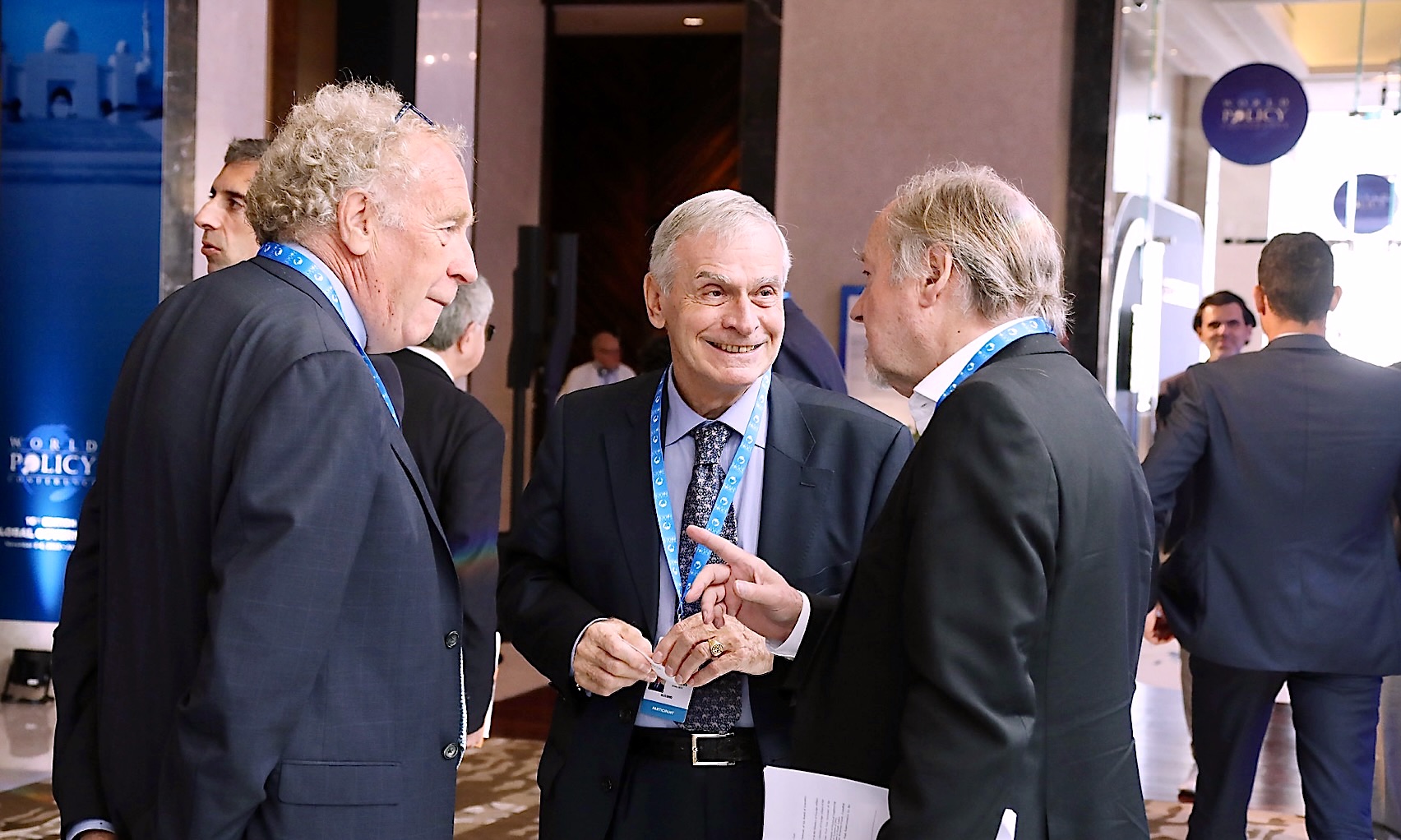
And he was active in EU foreign policy circles, attending events such as the World Policy Conference (WPC) in Abu Dhabi, UAE, in 2023 and 2024, where he mingled with senior EU officials, as well as Russian guests, such as teachers from the MGIMO university in Moscow, which educates diplomats and which is a storied recruitment ground for Russian spies.
The WPC was founded by another Russophile, French economist Thierry de Montbrial.
"In France, it's not unusual to speak with respect about Putin. There's a significant fifth column of intellectuals infatuated with Russia. Huby is undoubtedly one of them," one of the Western intelligence contacts said.
And whatever his motives, the net effect of Huby's behaviour was to have made senior staff feel unsafe, amid a wider Russian campaign of intimidation.
Emergency button for Euroclear staff
Moscow has threatened "decades" of lawsuits against Euroclear if it let the EU use its money for Ukraine.
"Preparations for a package of countermeasures ... are already underway," said foreign ministry spokeswoman Maria Zakhkarova on 4 December.
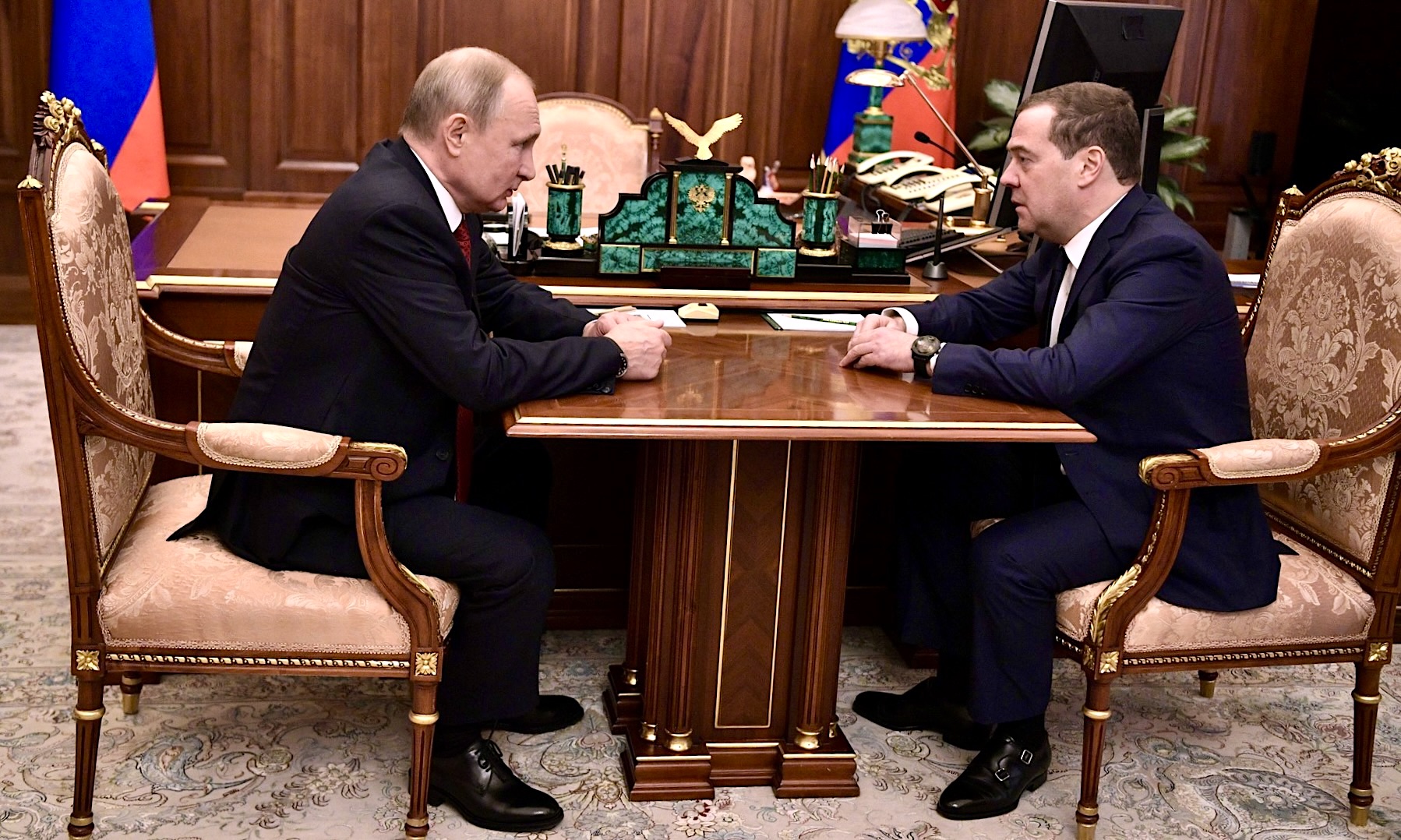
Putin's deputy security council chairman and former Russian president Dmitry Medvedev said the same day: "Russia may well view this move as tantamount to a casus belli, with all the relevant implications for Brussels".
Medvedev also threatened to nuke Belgium in November.
Suspected Russian drones have buzzed Belgian ports, airports, and military bases during the ongoing EU talks.
"Yes, we all see this. The Belgians as well. This is a measure aimed at spreading insecurity, at fear-mongering in Belgium: 'Don't you dare to touch the frozen assets'. This cannot be interpreted any other way," said German defence minister Boris Pistorius in Berlin on 7 November, referring to the drone incursions.
And for their part, rank-and-file Euroclear employees in Brussels also felt like they were in the firing line.
They were constantly being solicited for information via SMS, LinkedIn, WhatsApp, email, and social media by shady third parties, a staff contact said.
"I myself have been targeted about 70 times, I think, in the past two years," he said.
"Internal email is no longer secure, but the malware also comes through other channels," the source added.
Ordinary staff were advised to use shuttle busses from Brussels' North Station instead of walking from trains to the nearby Euroclear HQ.
The buses were put in place before the 2022 Ukraine invasion, partly due to crime around the station, but Euroclear staff now also had a new emergency-button app on their phones to alert corporate security if they were in danger.
And speaking of the elevated threat level post-2022, Churchill, the Euroclear spokesman said: "We live in a different world now."
"We've never been so busy safeguarding and protecting our people and the assets we look after as we are nowadays," he said.
"We've taken the appropriate safety measures … engaging a private security company [Amarante], if necessary, or working with the [Belgian] authorities – we have a very good relationship with them," Churchill said.

Molotov negotiations
But for its part, Amarante had no idea who Huby was, or that he had threatened Urbain, a source at the French firm said, even though it now formed the thin blue line between her and any outside forces who might seek to coerce her.
"Are you sure about that? Incredible … [sounds like] a spy movie, that!," the Amarante contact said when asked about Huby's Russia flights and alleged threats.
Several Amarante chiefs, including our source, have a background in French intelligence or security services.
The Belgian domestic intelligence service, the VSSE, which is also responsible for Euroclear's safety more broadly speaking, declined to comment on the record.
But a Belgian security contact gave a hint why authorities found Huby difficult to confront — his French nationality.
"We [Belgian authorities] were unable to fully investigate his [Huby's] activities: He doesn't live in Belgium", the source said.
And all this means that when von der Leyen's officials sit down with De Wever or Euroclear bosses for talks on Putin's money, some of their Belgian interlocutors might be worrying about their and their children's safety, instead of the legal or strategic merits of EU action.
Speaking of the kind of fears that might be on Urbain's mind, one of the EUobserver sources close to events said: "I wouldn't say her life was at risk. She doesn't decide on the future of the frozen assets, that's what Europe does".
Any decision on Russia's funds would be taken by the EU Council of 27 leaders, with De Wever's assent, and filtered to Euroclear bosses via Belgian finance minister Jan Jambon.
"But Valérie is an influencer in the whole process, that's for sure," the Belgian source added.
"So, I'd say: They [the Russians] might want to scare her by letting a go-between throw a Molotov cocktail at her empty car, but kill her? No. They just want to pressure her," EUobserver's source said.
This was a collaborative investigation by EUobserver, Humo, De Morgen, and Dossier Center
Every month, hundreds of thousands of people read the journalism and opinion published by EUobserver. With your support, millions of others will as well.
If you're not already, become a supporting member today.
Author Bio
Andrew Rettman is EUobserver's foreign editor, writing about foreign and security issues since 2005. He is Polish, but grew up in the UK, and lives in Brussels. He has also written for The Guardian, The Times of London, and Intelligence Online.
Related articles
Tags
Author Bio
Andrew Rettman is EUobserver's foreign editor, writing about foreign and security issues since 2005. He is Polish, but grew up in the UK, and lives in Brussels. He has also written for The Guardian, The Times of London, and Intelligence Online.